

There is a verse in Judges 9 that is easy to skip over. It sits between the drama of Abimelech’s rise to power and his eventual downfall. But once you truly see it, you cannot unsee it.
“In opposition to him these citizens of Shechem set men on the hilltops to ambush and rob everyone who passed by, and this was reported to Abimelek.”
Judges 9:25
Read it again slowly. The leaders of Shechem wanted to undermine Abimelech’s authority, to make him look weak and unable to maintain order. So they planted robbers on the roads to attack innocent travellers. Not soldiers. Not Abimelech’s supporters. Not people with any stake in their political dispute. Just ordinary people trying to get from one place to another.
These travellers were robbed, possibly killed, certainly traumatised, all so that Shechem’s leaders could score a political point about Abimelech’s inability to keep the peace.
The innocent suffered so the ambitious could advance.
If this sounds familiar, if it sounds like something you have read about in this week’s news, in reports of kidnappings, in accounts of coordinated attacks on communities ahead of elections, that is because it is. This evil is ancient. And it is still happening today.
“Political actors funding violence against civilians to destabilise their opponents. Creating chaos so they can position themselves as the solution. This tactic was not invented in the modern era. It has been in operation since Bible times.”
Nothing new under the sun
Judges 9:25 is not an isolated incident. It is one entry in a long and consistent biblical record of political leaders who deliberately sacrificed innocent lives to gain or maintain power. This is not collateral damage, the unintended consequence of conflict. It is collateral damage by design.
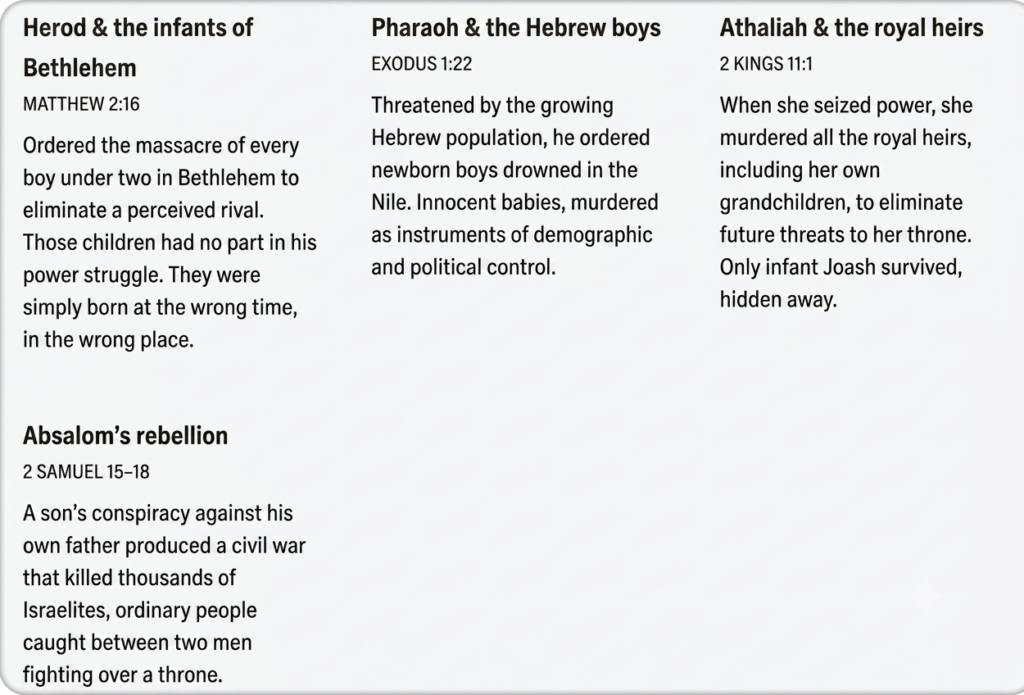
Ecclesiastes 1:9 says what is has already been, and what has been done will be done again. The tactics of political evil have not evolved. They have simply been recycled across millennia, wearing different names in different generations.
God recorded it. God repaid it.
Here is what needs to be said clearly about Judges 9: both Abimelech and the leaders of Shechem died violently for their wickedness. Neither escaped. The text is deliberate about this.
The leaders of Shechem, the very men who planted robbers to harm innocent travellers, eventually took refuge in the tower of El-Berith’s temple. Abimelech surrounded it and set it ablaze with everyone inside. About a thousand men and women burned alive. The fire they had started, politically and literally, consumed them.
Abimelech himself fared no better. Advancing on the next city, a woman dropped a millstone from the tower above and cracked his skull. Even in his final moments, pride consumed him: he begged his armour-bearer to run him through so it could not be said that a woman had killed him. The man who murdered seventy brothers to seize a kingdom died ashamed of how he was dying.
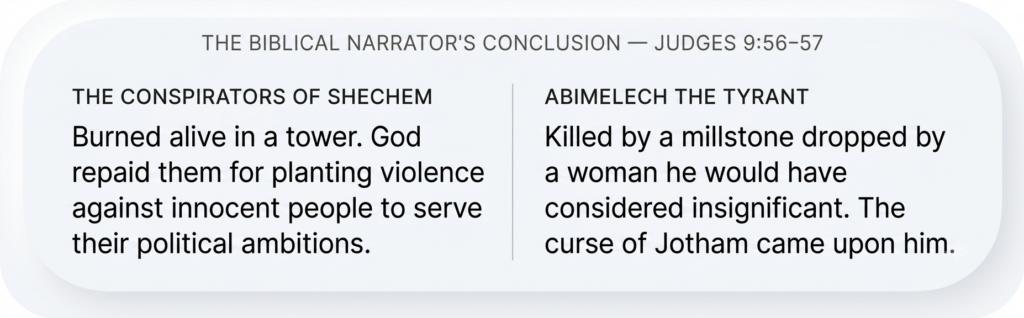
The innocent travellers sacrificed on those roads? God recorded their suffering in Scripture. The wicked who sacrificed them? God ended their lives violently and preserved their wickedness as a permanent record. Both sides died. The pattern holds across the whole of Scripture: those who harm the innocent for political gain face judgement. Herod died consumed by disease. Pharaoh’s firstborn died, then his army drowned. Haman was hanged on the very gallows he had built for Mordecai.
Justice may be delayed. Some wicked leaders live long lives and appear to escape consequence. But God sees, God records, and God repays.
“Do not fret because of those who are evil or be envious of those who do wrong; for like the grass they will soon wither… A little while, and the wicked will be no more; though you look for them, they will not be found.”
Psalm 37:1–2, 10



2 thoughts on “When the Innocent Pay for Political Ambition”
This is a very Powerful truth bro.😇
History may forget many crimes but God never does.
The delay of judgment should lailai be mistaken for the absence of judgment. In the end the Judge of all the earth will do what is right o.
May God continue to grant justice, comfort the afflicted, and turn hearts toward righteousness. 🙏🏽
And may God in His infinite mercies heal our land and comfort every victims of insecurity in our nation.
May every victims of insecurity be miraculously rescued and may we not be victims of insecurity in Christ Jesus’ name.
More wisdom Sir.😇😊
God gat us all.
Amen.
Vital prayer. Thank you ma’am.